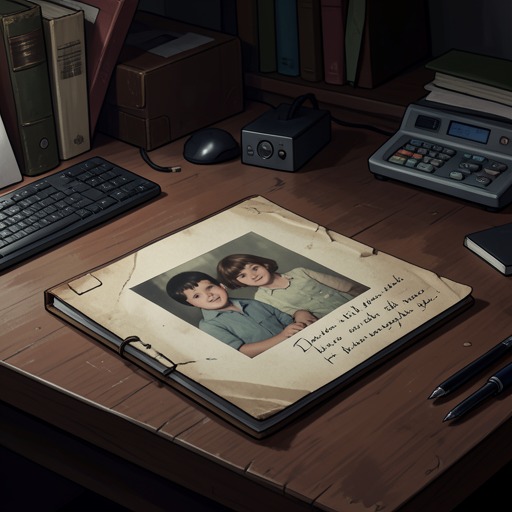
The disappearance of Peter Savage and Jamie Rowan
In the WoodsThe disappearance of Peter Savage and Jamie Rowan is the unresolved 1984 case at the center of Rob Ryan’s buried childhood and later investigation. The two children vanished after spending an afternoon with Adam Ryan in Knocknaree wood; Adam was found there during the search, but could not remember what had happened. Years afterward, recovered fragments offered new context for the children’s last hours without resolving their fate. The case’s force lies partly in that gap: evidence and memory return, but the answer does not.
The Disappearance and the Search
In 1984, Peter Savage and Jamie Rowan disappeared from the Knocknaree area. Adam Ryan had been with them that afternoon. Searchers found him in the wood a couple of hours into the operation, shaken but without injuries; there was blood in his shoes, and he could not recall what had happened. The surviving account establishes neither where the missing children went nor whether they left the wood. Their disappearance remained an open case rather than a resolved account of their fate.
The search, as retired investigator Kiernan later recalled to Cassie Maddox, was extensive. Dogs, helicopters, and divers were deployed, while police officers and volunteers searched the surrounding wood, hills, and fields for weeks. Investigators followed leads as far away as Belfast, Kerry, and Birmingham. The scale of the effort did not overcome its central difficulty: despite searching in many directions, they found no answer that explained the children’s disappearance.
Kiernan retained a suspicion that the search had been directed the wrong way and that the answer might have been close at hand. His theory was that the children had never left Knocknaree. He thought a local person might have watched them, approached them in or near the wood, and lured them to a nearby house. In this account, Adam escaped and returned to the wood while Peter and Jamie did not. Kiernan speculated that the other children might have been killed and their bodies hidden or disposed of, possibly in the wood. These were investigative conjectures, not established findings; the narrative supplies no confirmation of the children’s fate or of Kiernan’s proposed explanation.
Adam Ryan and the Case’s Afterlife
For Adam, the disappearance did not end when the searchers found him. His inability to remember the day became part of the case and of his identity. As a boy, he knew that Peter and Jamie had disappeared and imagined that they might return. At boarding school, he was intensely homesick and pictured Jamie beside him or Peter in the next bed. He sent imagined messages to them in bottles floated down the school stream, linking their return to the possibility that he could go home. The disappearance thus persisted not only as a police inquiry but as a private expectation that the lost children might still reappear.
As an adult, Adam kept his connection to the case secret from almost everyone. His parents and Cassie Maddox knew, as did a few people from his earlier life, but he did not tell colleagues generally. At boarding school he had dropped the name Adam and adopted his middle name, in part because publicity about the disappearance had made him recognizable. When a later investigation seemed capable of connecting with the old case, he knew he should inform O'Kelly. He chose not to: disclosure would likely have removed him from the case under the rule against investigating matters involving personal emotional conflict, and might have subjected him again to questioning about the day in the wood. He also admits that the idea of carrying an unsuspected secret appealed to his ego and to his sense of himself as an enigmatic detective. His silence therefore both protected him from renewed scrutiny and compromised his position on the investigation.
Recovered Memories and New Questions
The old evidence made the case newly immediate. In a police basement, Adam examined items kept from his childhood: clothes he recognized as his but did not remember wearing, blood-marked running shoes, and Peter Savage’s Donkey Kong game. The game briefly brought back an image of Adam and Peter playing while Jamie watched and called instructions. The other objects did not unlock a continuous memory. Instead, the smallness of the clothes and the Mickey Mouse drawn on a shoe underscored how distant his childhood felt from him.
The clothes also raised unanswered questions. Adam had read about the parallel rips across the back of his T-shirt but had never seen them before. He could not explain how they had been made. When he realized that the shoes might be sent for new forensic testing, he understood that the old disappearance could return to active investigation. A DNA result might prompt comparison with blood evidence from the altar stone and lead investigators to seek samples from Peter Savage’s parents, Jamie Rowan’s mother, and Adam himself. This was a possibility he feared, not a result the account reports. The evidence offered a route to renewed inquiry, not proof of what had happened to Peter and Jamie.
Under the pressure of the investigation, Adam began deliberately trying to remember. He walked for hours, sometimes in the early morning, and found that images surfaced in fragments rather than as a reliable, complete account. One recovered memory placed Adam, Peter, and Jamie near a clearing where they witnessed a violent attack on Sandra Scully. The recollection establishes that the children saw something dangerous; it does not establish that the attack caused their disappearance or explain what happened afterward. The difference matters: a vivid fragment can change the questions raised by the case without supplying a verified solution.
An Unresolved Ending
Adam’s recovered memories did not remain securely available to him. After Operation Vestal, during months spent alone in his apartment, he turned his thoughts back to Knocknaree and found that the scenes he had worked to retrieve were gone. He could remember having remembered Peter, Jamie, and the events in the wood, but those images now felt remote, like scenes from an old film or stories heard from someone else. He feared that even these distant impressions would eventually disappear. Only one image of Peter remained: the two boys trying, unsuccessfully, to make a periscope from rolled newspaper because they had no cardboard tube.
The disappearance therefore ends without a disclosed resolution. The police search, Kiernan’s theory, the recovered evidence, and Adam’s unstable memories each bring the case into sharper view, but none confirms where Peter Savage and Jamie Rowan went or what happened to them. Its narrative structure echoes that uncertainty: the reader receives pieces of the past through Adam’s delayed and repeatedly lost recollections, while the children’s absence remains the fact those pieces cannot repair.